Showing posts with label Finance. Show all posts

Monday, March 7, 2016

.::. 2016 Resolutions .::.


This was in draft for months, and before I got it published, it's already March!?

2015 Resolutions (and some of 2016):

1. Be more disciplined with exercise and diet to reduce fat % and become leaner/stronger.

While I have gotten stronger and have been keeping an active lifestyle, I don't think I got leaner nor reduced my fat %! This is a constant struggle especially after I started driving to work and consequentially walked less. We did spend more days strolling at Botanical Gardens and brought Chikey to Sentosa to swim and stroll at Sentosa Coast after we got our car though.This shall be a constant work-in-progress every year!

2.Reading more news and books to enrich myself and to meet my financial goals this year.

We have been pretty disciplined and have not spent much on big-ticket items this year. Even holidays were pretty muted to Indonesia and Boracay, Phillipines this year. I also took up additional tuition assignment out of interest and for more supplementary income to cover our addional petrol expense or my music lessons. To some extend, this also helps to mitigate earned salary-risk, given that my income and job was not exactly stable with a 25% workforce reduction in 2015. Financial goals were on target or slightly ahead. We need to persevere 10 more years before she finish our mortgage and become financially free. Hoping to be more disciplined with savings to be ready to take advantage of any market downturn.

3. Learn a new instrument – violin and piano

After starting violin lessons in January and piano lessons in March, I took my ABRSM Grade 3 in February 2016. It took considerable hard work and some stress towards the end, but I'm so glad of the progress I've made. People think I'm crazy, I think I'm crazy too, but it has brought me immense pleasure in playing and making all these progress. There’s still a long way to go, but I hope to continue on this journey in the many years to come!

4. Reduce clutter and organize the home.

We did quite a thorough spring cleaning before Chinese New Year! The house is the cleanest since we moved in, but I still need to continue de-cluttering and organizing my (many) stuff.

5. Experiment with new recipes and cook/bake more often.

Highlights of the year was Prawn Noodle Soup, Chicken Rice and steamed fish! I also cooked for my family's reunion dinner in 2016! I haven't baked much though, it's too fattening and the husband doesn't like sweets.

6. Finish ACCA

Like finally! *wee. No more guilt for not spending my weekends studying and no more night classes! You know what's worst than studying or working? Studying AND working. I can't believe how I used to rush to classes after work and got home past 11pm, only to get up at 5am for work, and still have to find time to study among everything.

2015 was a year with many milestones, but has not been very lucky for me. For one, I lost my wallet the first time in my life, together with all my cards. The wallet was 5 year-old but in very good condition, purchased in New York during one of our trips. I also dropped my phone and cracked the whole screen epicly. Work has not been the smoothest too given the downturn in O&G and dreary environment. There were also many hospital admittance for the family. But as a whole, it wasn’t too bad a year as we still chugged along happily and I achieved most of what I set out to do in 2015.

2016 is supposedly a good year for both of us, and I indeed had a pretty good start.

In 2016, I hope to continue the momentum and make more progress on these core goals.

1.       Stay active and healthy – now that we’ve a car, we do walk less but we can do more. I hope to have more active weekends since the husband does not like to exercie. Shall plan more walks to botanic gardens and MacRitchie, and to bring Chikey out more often to the beach. I also hope to continue my weekly gym sessions and I’ve been planning to start Kayla’s BBG program again. I also cook less often now that we can quickly and easily drive out to eat. I also pick the husband up often, and drop by somewhere for dinner before coming home. So hopefully, I can continue cooking few times a week for more nutritious and healthy meals.

2.       Save and Invest – We are pretty much on-track for our 10-year plan, but it might be more challenging with a car. Given our current lifestyle we should be alright, especially since we’ve cut down on traveling.

3.       Do more – Although the husband and I donate monthly, and I take part in charity programs now and then, I hope to do more for the less priveledged. I have been urging the husband to join me to do some volunteer work but he hasn’t been too keen about it. He thinks that I should take the time to do more for our place (like more housekeeping and packing my stuff) instead of spending the time to do others’ place. =_=” Perhaps we can work out a few one-time off events to volunteer at. Children and animals always have a special place in my heart.

4.       Practice more -  After my Grade 3 exams for both violin and piano early this year, I hope to play more of what I enjoy instead of preparing for exams! Looking forward to work on my dream pieces and perhaps save for a violin upgrade.

5.       Love more – life is too short to be too busy for your loved ones. Broadly, this includes more cooking, more housekeeping, more quality time together with all my loved ones.

I can’t believe that I will be turning 30 very soon I have turned 30. I don’t feel like 30, although I do feel that at this age, I am in better control of my life in all the different aspects. It might be a scary thing to age for some, but I realized that time gives you a perspective that nothing else could.

Time. Time is a very scary thing that is slipping away every second and can never be recovered. I was looking through my old stuff like photos from secondary school and my studying materials in school and from my time in Sweden. I threw most of them away, but I feel this sense of loss and emptiness, like I can't bear to let go of those wonderful times. It's another topic all by itself, but well, time pass us by way too quickly.

The husband is away yet again on a work trip. It's during these times when I'm home-alone and free that I spend more time reflecting. I know right, how did he become such an integral part of me that I feel a sense of emptiness and a dull ache of loss without him?

To another wonderful year ahead! =)

Thursday, June 25, 2015

.::. Insurance .::.

This struck home recently as a close one suffered from a sudden heart-attack at barely 40 years-old. Due to proximity and criticality, she was admitted to a private hospital nearest the workplace. Few days and an operation later, the hospital bill came to a 6-digit figure. She’s still in the ICU, and it’s still a long journey ahead. With just the basic MediSave without additional cover, it covers a very small fraction of total cost. It’s really a stressful period as the family have to cope emotionally and financially.

Just this year, we finally sat down to do some financial planning for the family. For years now, since before marriage, I have been trying to get the husband to examine his insurance policies and coverage. Being financially trained, I see the importance of insurance and financial planning early in life, as soon as possible. The husband has been someone who does not like to handle stuff like that. His policies were bought by his parents and he was always told that he ‘has everything’ and is covered, no need for more insurance. This dragged on for years as he was reluctant to take any action.

Finally, we looked through his policies this year as I was also looking to increase my coverage. He has a hospitalization plan that does not cover the deductible portion plus a cap for total claim amount and an NTUC plan that covers a grand total of $25K. Needless to say, I was horrified and insisted on getting him covered. The $25K coverage will not even cover his funeral expenses, I morbidly exclaimed.

My advice to all working adults is to get full hospitalization cover as soon as possible. I’m the ‘buy term and invest the rest’ type, and also have (early) critical illness coverage - 不怕死,只是怕不死。(loosely translated as ‘not afraid of death, only afraid that one do not die’). Any illness or accident can potentially wipe out decades of savings with unimaginable financial and emotional stress for the family.

My dad is someone who does not believe in insurance and always complained about the profits made by insurance companies. He also thinks that it’s ‘expensive’ since insurance companies have the right to increase the premiums anytime during the coverage. However, when premiums increase, it usually reflects the increase in healthcare cost. He also thinks that Medisave ‘is enough’ and he does not mind being treated in public hospitals. However, I beg to differ and have come across so many instances where Medisave is grossly inadequate and that public hospitals might not give the best or even ‘sufficient’ care when you need it most.

I will always remember the sight when we visited his grandmother at Changi Hospital. It was a 6 or 8 bedded non-aircon ward with no full walls across the whole level. ‘Rooms’ were separated by chest-level walls, and you can look across the whole level and hear everything. There were many old people, some in worse condition than others. Many were groaning in pain or perhaps trying to talk. It was a very disturbing sight that never fail to haunt me. I hate hospitals. I have also been to many public hospitals, and the nurses were curt and sometimes rude and lack patience and compassion. Doctors were often trainees who does not seem to be very sure of what they are doing. I have also heard of many horror stories and bad experiences around me. Compare that with a private hospital - the whole environment, doctors and nurses are really a world apart. It really hit me that you get what you pay for. If I ever need the hospital and critical care, I really would want a comfortable environment and not have to worry about bills.

Of course, the best insurance is always taking good care of one’s health with regular exercise and a balanced diet. Go for regular checkups and listen to your body. However, one really wouldn’t know when sickness may hit, especially with longevity. Get insured before anything happens and you become uninsurable. I’m very thankful to have met a really great insurance agent who gives me constant updates and informs me whenever he’s out of town. I am also invested in healthcare stocks and funds, which I believe is a growing yet resilient industry.

Health is wealth and nothing is more important than one’s health! While physical health is the focus here, mental health is also something one should be mindful of.

If you are not covered by insurance yet, please do your family a favor and consider getting covered.

Saturday, August 2, 2014

.::. Retirement Planning – Where to start? .::.

Although retirement planning has been on my mind for a long time and I have started my CDP account years ago, I only started my own portfolio this year. One of this year’s resolution is to consciously grow my portfolio for financial freedom and retirement. I revisited a lot of stuff that I’ve learnt from my finance and accounting background to look into companies’ balance sheets and spent a lot of time reading financial news. My initial capital for my portfolio was from the ILP that I bought as a 21-year-old student – that has made me 1% p.a. for the past 7 years with dollar-cost averaging. Investment-linked-plans has got to be one of the worst investments to get most of the time because of the high fees, non-guaranteed returns and expensive insurance component involved. No real finance person would actually recommend ILPs, although many insurance agents are actively selling it. I wanted a regular savings account then, but the banker sold me an ILP instead. It didn’t turn out bad for me, since I would have probably spent all those money during my year in Europe if not for the ‘forced’ savings.

It’s a universal rule that the rich will always get richer while the poor will find it difficult to get out of their poverty cycle. Of course, there’s always exception to the rule, but the lack of financial literacy, even among educated graduates is almost appalling. How many actively manage their money and do financial planning? Most do not want to spend time learning or simply dislike even thinking about it. It has become a reality that we can’t retire or become comfortably ‘rich’ without actually investing in one way or another. It’s getting tougher to be comfortable in Singapore, but one can continue complaining or choose to find ways to get around rising cost. Without good finance management, it’s going to be very difficult to be survive in Singapore. It doesn’t mean having a finance degree, but simply learning the basic skills and knowing the importance of managing one’s own finances.

Singapore has many millionaires, and what is interesting is that many of them (let’s not count the imported ones) are actually working professionals who have worked and saved hard throughout their working-life to get there. It isn’t that difficult to become a millionaire really, because of the power of compounding interest over time. If you save about $700 a month at about 8% interest p.a., you will become a millionaire in 30 years. And if you save about $1700 per month at about 8% interest p.a., you will become a millionaire in 20 years. $700/month or $8400 a year isn’t that difficult if you take into account 13th month and bonuses for most people, since medium household income is at $7,870 in 2013 – simplistically, becoming a millionaire household would materialize by saving the 13th month pay conscientiously for about 30 years with an interest rate of 8%.

Singapore is also a great place to invest or start a business due to our laws. We do not need to pay tax for dividends received, we do not pay tax for capital gains from investing in stocks and property. There are people who actually receive more dividends monthly than their salary and do not pay tax on those dividends. If you start a business as a private limited, you only lose what is invested. If things don’t go right, you simply close the company and open a new one without having to pay your suppliers/customers (and people charge their expenses such as car and meals to the company).

So, the millionaire question – where do we start?

There’s only one answer.

Save.

Spend less than what you earn and save conscientiously. The earlier in life and the more you save, the quicker you can be financially free.


After that, you can learn how to make your money work for you.

Li Ka-shing’s article has been a great hit some time back and teaches many useful principles, although I don’t exactly agree with the networking one. Basically, he recommends one to split their income into different buckets – for daily expenses and necessities, savings to invest, for self-enrichment, for travel and re-charging and for networking. The main concept as I read is to be frugal early in life and only spend what is needed, then learn how to grow your wealth. You can then do whatever you like when you become rich.

Step 1: Save
Always put aside some money from your paycheck every month that you do not touch. What I do is to have a few bank accounts and set automatic transfers a day after my payday. Part of it is transferred to my savings account that I do not touch, part of it is transferred to our joint account that we do not touch (with the exception of some holidays and bigger ticket items for our home), and what’s left will be what I can spend. I’m quite flexible with what is left for spending and not too frugal day-to-day. This works for me because I can spend freely from my spending account, and will still have a good amount of savings every month that ‘I do not see’.

Step 2: Insure
That’s what people usually recommend, and the basic would be to get a term plan and a health insurance. I think a good health insurance to cover your healthcare costs is important as any huge hospital bill can derail all your plans. I also have a term insurance that my mum got for me a long time ago. Both of them cost me about $100/month currently. Our housing insurance is paid to HDB through CPF, and if anything happens to me the housing loan is ‘free’. I don’t see a need to get any other plans such as critical illness plans now since I have no dependents and my parents do not need my support, neither do my husband. If anything happens to me, the flat is free and there’s the term plan, my endowment plan, plus my investment portfolio to generate some passive income. I would rather use the money to grow my portfolio and self-insure at this point of time. It might be different if you’ve parents to support or someone that has to depend on you. And hey, instead of spending so much on insurance, why not spend some time exercising and being more health-conscious!

Step 3: Invest
When you’ve put aside an emergency fund of at least 6 months to a year of your expenditure, and have some money left idle, it’s time to make your money work for you. I think it’s important to have some concept of investing and know what you are investing in. It may be daunting for those without finance background, but with interest and some reading, it’s possible to develop financial literacy. But if you do not want to spend much time on it, buying an ETF (exchange traded fund) such as our Straits Times Index might be a good start. There are monthly saving plans into the STI available, meaning that money is deducted from your account to invest automatically every month. The cost is low and you gain from dollar-cost averaging over the years. Other stocks like Singpost, SPH and  our telecommunication stocks – Singtel, Starhub, M1 also pays high dividends and have remained quite stable over the years. REITS can also be a good source of passive income. Investing is a whole huge topic by itself and it takes some time and effort to learn.

Some local financial bloggers to check out:

Here’s one blog that I really like and find useful. His income from S-REITS dividends alone was S$ 118,081.02 in 2013 and S$ 123,873.80 in 2012 . He’s in his mid-40s and have remained anonymous. He shares many of his trades and views on financial literacy but does not give disclose specific details of his portfolio. There are many easy-to-read posts dedicated to new investors and may be a good starting point.

This other blogger who received >$1000/month in dividends before he turned 30 and shares all details of his actual portfolio:

There’s a lot of information and analytical articles, and a tracker for high-dividend Singapore stocks:

This guy is my age, and have saved a larger portion of his tuition income than me and tracks his monthly expenditure and portfolio:

 Start now!

Thursday, July 17, 2014

.::. Retirement Planning – Start Now! .::.

I suppose many of us would have our own vision of retirement, and it’s eventually something which we would like to be able to do someday. It does seem to be increasingly difficult in Singapore as the years go by with the relentless increase in prices. People always find it incredulous when I say I’d like to retire soon – but that soon is probably a good 10 – 15 years away and it takes years of planning, saving and investing to eventually get there. My definition of retirement is being able to sustain a comfortable standard of living and being able to do what I like, whenever I like it. I don’t see myself needing much, spending my time on exercising, cooking and picking up some hobbies. I see myself volunteering, perhaps in animal shelters or working with less privilege children, maybe teaching and helping to set up schools in remote areas. I might set up a small online retail business, perhaps DIY some stuff and learn sewing. The husband and I have a private joke – that we will work in MacDonald’s together for some extra income and free food after retirement. Imagining us both old and in Macdonald’s uniform always puts a smile on my face.


Having said that, the current projection is to be financially free when we are around 45 – 50 years-old. It’s when our mortgage is fully paid and when our future children become almost fully independent. And of course, without kids in the picture, we can probably shave 10 years off the number. Perhaps it’s my financial background or perhaps it’s how my family has embedded the importance of money and savings since I was a child – I committed to my first regular savings plan when I was 21. It was an ILP which I have terminated this year, and I was lucky to make 1% p.a. despite the high fees throughout the 8 years. I was lucky to buy units very cheaply during the financial crisis that covered the hefty ILP fees. ILPs are definitely not the best way to grow your money, but without that, I wouldn’t have saved that 5-figure sum that was left untouched throughout the years. I also started a 15-year endowment plan when I was 25 for forced savings, and it matures when I’m 40. Many people started earlier, but many people have not started too. All too often, we hear complaints about how things are expensive and how retirement is but a dream – but these people need to understand that retirement requires years of planning and saving, sometimes making some sacrifices today for tomorrow’s freedom. What’s the point of complaining but not trying to find a way around it?

While I come from a middle-income family, my parents started out poor and have been thrifty all along. I started working at 15, during the June school holidays. A friend referred me for a job at Republic Plaza’s Coffee Bean. I worked for about a year there, part-time during school time. When my peers hung out at malls after school, I made coffee and cleared tables till late. It wasn’t that common around me, because most of my peers came from good families with ample pocket money to spend while my dad has always been very stingy with my pocket money. I hated asking for money, having to justify for why I needed it. I hated being dependent and not able to make my own decisions. I worked till I was 16, when I spent the last few months concentrating on my O’Levels. After O’Levels, I intended to take the Polytechnic route, and started working at DFS in the airport as a cashier at the Liquor and Tobacco shops. Money was pretty good and every single receipt keyed-in earned us an additional 5 cents in addition to our hourly pay. I ended up in Junior College, and worked every school holidays and sometimes during weekends for road shows selling things like Singtel/SPH subscriptions. I took up whatever odd jobs that the agency offered, mostly sales. I started teaching tuition after JC, throughout my university years. When I took up my first job upon graduation, my starting pay was lower than what I earned from part-time tuition during tertiary days. It was a big deal, because I charged barely $20/hr and my student base grew through word-of-mouth. Money was good, because they formed their own groups. Most of the days, I taught for 6 hours a day, back-to-back as they came to my place. Although I’ve wanted to stop teaching as it’s really tiring to teach 2 hours after work, I’m still teaching a few students now, for interest and some extra pocket money. Teaching has always given me the most satisfaction among all my ‘jobs’.

My parents would think that I’m a spendthrift, although I have always saved a large part of my income before spending. I’ve indeed spent a lot of what I earned on CDs and gadgets during my teenage years, and I’ve spent quite abit traveling around the world in the past few years. I guess there has to be a balance, in trying to save up but still being able to experience as many things as possible in life. Every penny spent on traveling has been worth it, as it has opened my eyes and changed me in incredible ways. The husband and I have also created many memorable travel experiences and developed together as a couple. We have always traveled quite frugally, never spending much on accommodation and food. I often wonder when can I travel Europe and enjoy their beautiful hotels and restaurants instead of backpacking and staying in hostels. We did have many unforgettable adventures with our backpacks though, and those memories are priceless. Now, we have also made the conscious decision to delay the purchase of a car and save as much as possible these few years before kids come along and expenditure rises. We can probably afford a car comfortably now, but that would also mean at least $12,000 a year lost in savings. I put aside more than half of my income nowadays, transferred to different accounts to prevent myself from seeing it and spending it. It makes me feel perpetually ‘poor’ and I sometimes delay my purchases till the next paycheck. This helps to rein in my expenditure.

Most people start their retirement planning too late and underestimate the power of compounding interest. What you choose to save instead of spend today will have far-reaching effects in the years to come. There’s also a big difference between saving up first before having children and having children first before saving up! People don’t get it why we want to delay having kids and see no difference in the expenditure now or two years down the road. I beg to differ!

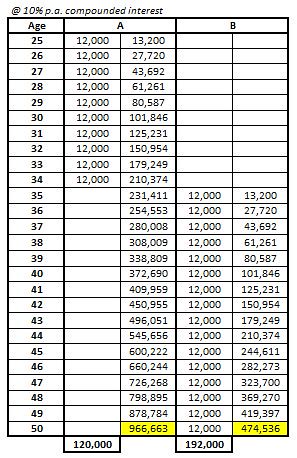
I have started my own portfolio of investments late last year, and would expect to make about 12% return this year through dividends and capital gains. To illustrate the power of compounding interest with a very simplistic illustration, assuming 10% p.a. compounded interest: If A were to save $12,000 a year for 10 years between ages 25 and 34, but stop saving after expenditure rises when kids come along, he will end up with $966,663 when he is 50. Compare that to B who starts saving $12,000 a year from age 35 till 50, he will have $474,536. Although B saved more than A, B has about half of what A has at age 50. Moreover, A doesn’t even save anything between ages 35 and 50!  If the portfolio generates 6% dividends, a $1 million portfolio would have about $60,000 p.a. income, and that would be sufficient for a decent retirement lifestyle without even liquidating anything.


Compounding Interest at 10%

Of course, there are many variables throughout the years and cynics will have many reasons why this wouldn’t work. Some may even complain how difficult it is to even survive in Singapore, let alone save. Circumstances do change, but that doesn’t mean that plans should not be in place to react accordingly. As a matter of fact, it was worked for many regular working-class people, and some of them have shared their knowledge freely. For most, it’s not that difficult to save $1,000 a month when you have very little commitments in your twenties. It can be your bonus and AWS with a few hundred every month. Even if you save less, you will get there eventually with consistency throughout the years. Some may say that a 10% return is neither guaranteed nor achievable, but there are many books that one can read to improve their financial literacy to help you achieve that. Singapore shares represented by STI have generated a 8.8% total annual return for the past 10 years, not taking into account dividends. There are many Singapore companies which have given out a consistent dividend payout of around 5% the past many years. With a long time-horizon and taking advantage of market downturns, it really isn’t that difficult.

The good thing about such planning is that anyone can do it. You don’t need to come from a rich family or have a huge capital to start. It’s possible for any regular working adult who is willing to save a couple of hundreds a month, every month, for a good 10 years. It becomes increasingly difficult to have a good job beyond a certain age and our employment income faces an increasing risk as we age. You don’t want to be 50 and have to work till 60 or even 70 because you do not have enough to retire.

I do hope that Singaporeans would become more financially savvy and start planning their finances early in life. Investing is not the same as gambling. Singaporeans are very lucky to have no tax for capital gain and dividends received, and investing is a very good way to accumulate and preserve your wealth without letting inflation erode it. Hopefully, I will be able to impart my financial literacy to my future kids and help them have a head-start in life.

And maybe, someone might be inspired to start their own retirement planning. =)